
Slab Demolition Is More Complex Than Most Homeowners Expect
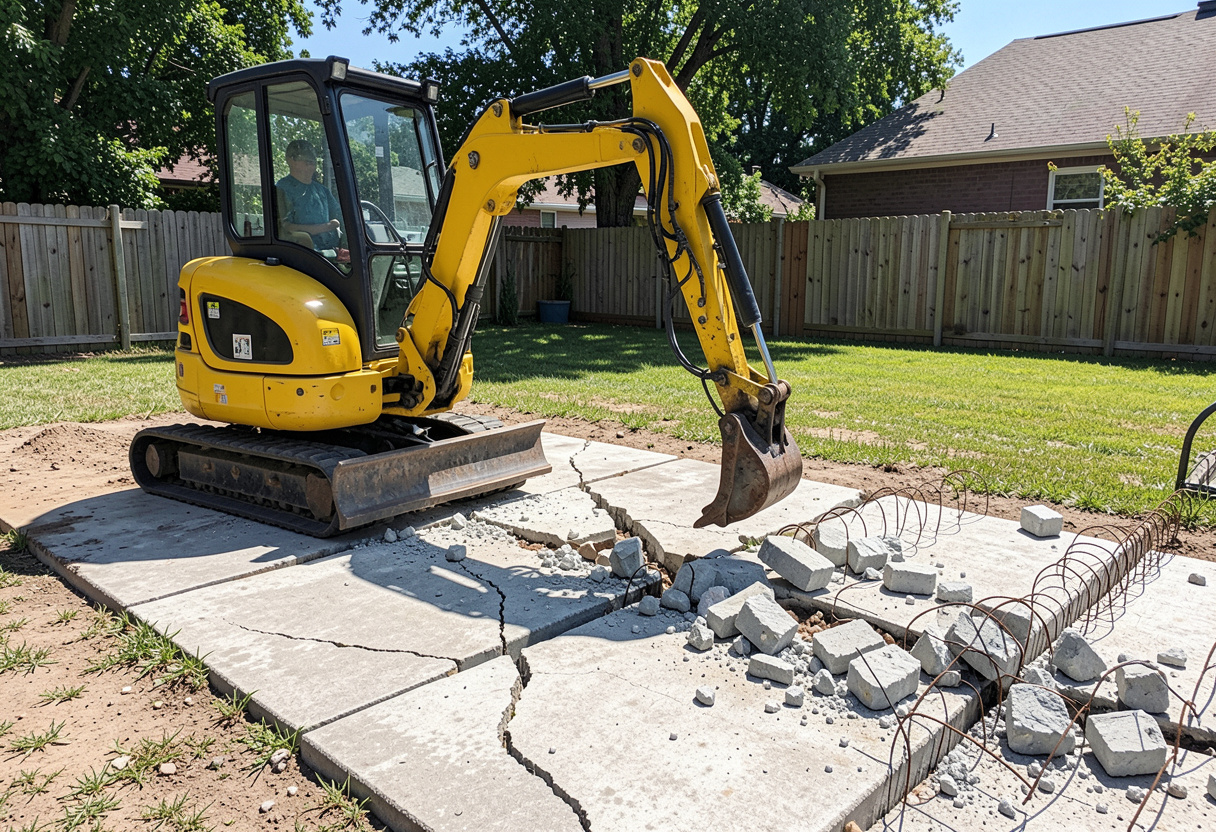
Most homeowners don’t realise how much goes into slab demolition until they’re standing in their backyard staring at a six-metre patio that needs to come out before Monday. A concrete slab — whether it’s a full house slab, a garage floor, a shed base, or a pool surround — is a reinforced structural element. It doesn’t just crack apart cleanly with a sledgehammer and goodwill. It needs to be broken methodically, the steel cut as you go, the rubble loaded and carted off, and the sub-base left in a condition that’s actually ready for the next stage of work.
Get it wrong and you’re dealing with damaged services, cracked footings on the neighbour’s side, or a site that’s more of a mess than when you started.
We’re Gold Coast’s slab demolition specialists — and we bring the right equipment, the right method, and proper site management to every removal project, big or small.

The Types of Slab Demolition We Handle
Not every slab is the same job. Thickness, reinforcement, access, and proximity to existing structures all change how a removal gets done. Here’s what we handle across the Gold Coast.
Equipment Selection & Site Access
Slab demolition equipment ranges from handheld jackhammers and angle grinders all the way through to full-size excavators with hydraulic breaker attachments — and the right choice depends on slab volume, thickness, and site access. On Gold Coast residential properties, backyard slab removal regularly involves a side-gate access assessment before the job starts. A standard residential side gate might be 900mm wide, which rules out a standard excavator and means a compact machine is the right call.
Getting that assessment wrong and arriving with equipment that can’t get through the gate doesn’t just slow the job down — it delays your whole project. We inspect site access as part of every pre-job walkthrough and arrive on day one with equipment that’s already matched to what the site allows.
Slab Demolition Across the Gold Coast
Knockdown rebuild projects in established suburbs — Nerang, Mudgeeraba, Burleigh Heads, Robina, Coomera — mean original house slabs from the 70s, 80s, and 90s are regularly being stripped out ahead of new construction, and those older slabs often have inconsistent reinforcement and sub-base conditions that a professional crew needs to read and respond to. Renovation activity across the northern suburbs and canal estates means garage upgrades and backyard transformations are a constant — replacing tired old shed bases and worn patio slabs with new decorative finishes.
And beyond residential work, the commercial and industrial development happening across the Gold Coast corridor means large-scale slab removal ahead of site redevelopment is a regular part of what we do.
Underground Services & Structural Considerations
Before any breaking starts on a house slab, every underground service in the removal zone needs to be located. Plumbing penetrations, electrical conduits, and drainage lines run through and beneath residential slabs — cut through a live service mid-demolition and you’ve turned a slab removal into an emergency repair. Service locations are identified during the pre-job inspection and marked before equipment is ever switched on.
The same approach applies to slabs sitting adjacent to existing structures being retained. Breaking without saw cutting the boundary first risks transferring crack energy into the footings or slab edge of a building that’s staying — and that’s a problem that’s expensive to fix and completely avoidable. Careful saw cutting and controlled breaking methodology near any retained structure is standard practice, not an optional extra.
Concrete Waste & Responsible Disposal
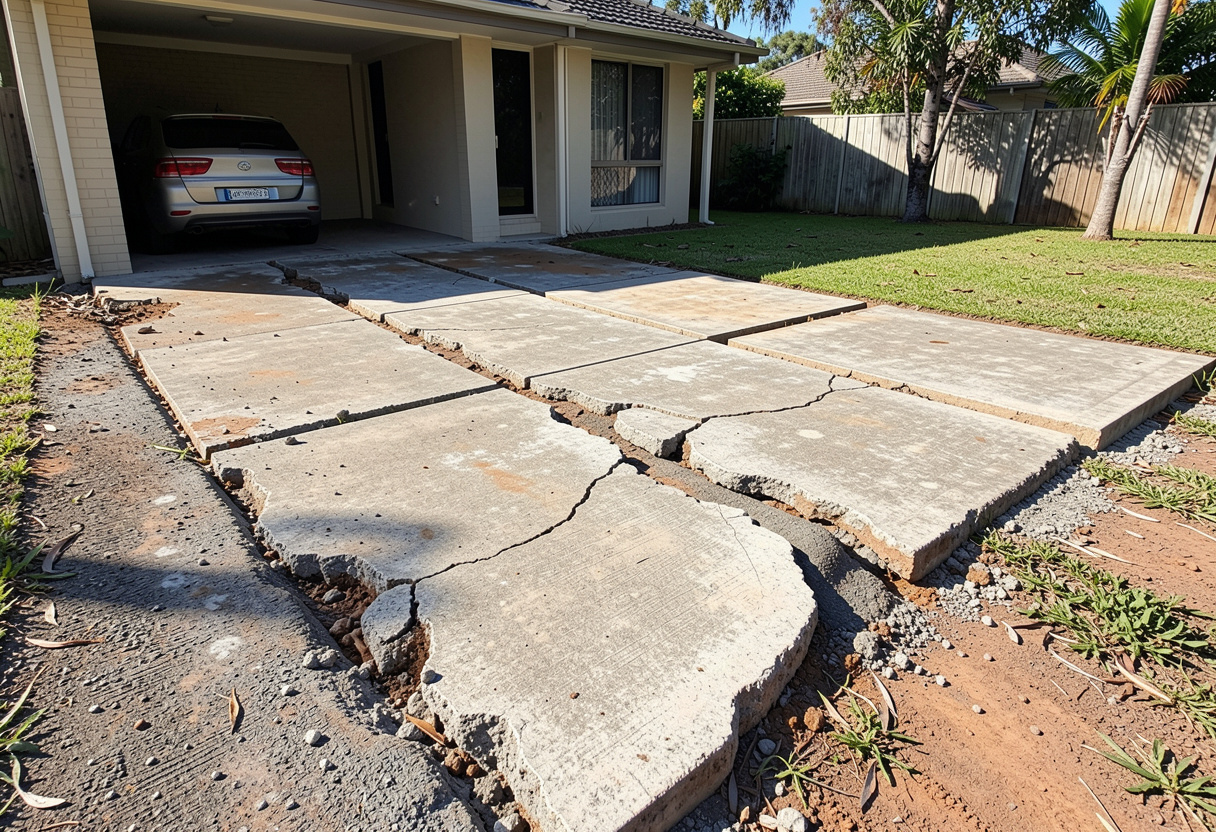
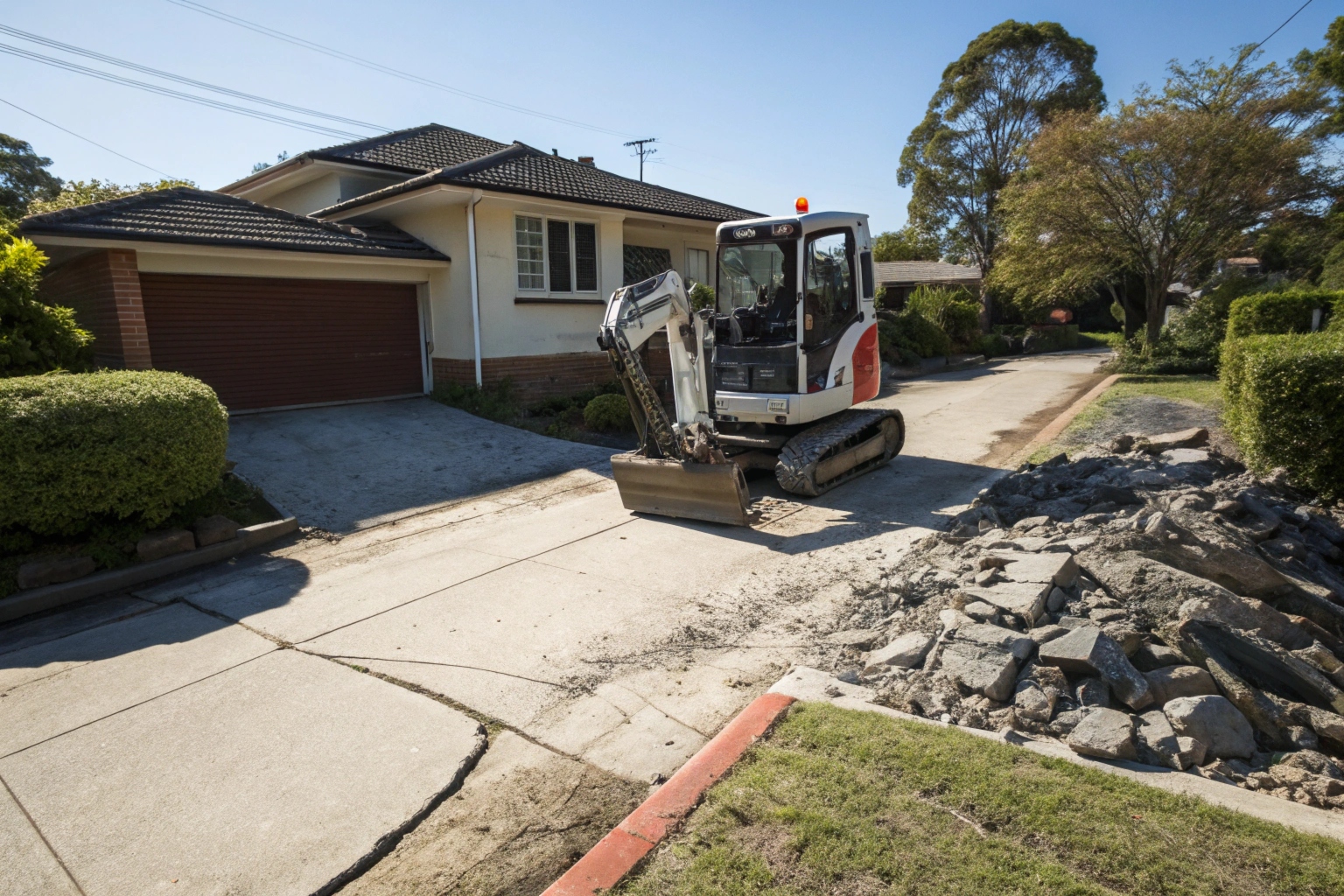
A standard house slab generates a serious volume of broken concrete rubble — more than most people picture when the job is still on paper. Managing that volume is part of what makes a slab demolition run smoothly or grind to a halt. We handle the full removal and disposal logistics, carting broken concrete to licensed facilities where it’s processed and recycled as crushed aggregate for road base and construction fill.
Responsible disposal is how we do it on every job — not because it sounds good, but because it’s the right way to run a site. Once the slab is out and the site is clean, the exposed ground tells a story worth reading before any new work begins. Compaction, contamination, soft spots, and drainage issues all show up at sub-base level — and identifying them now means they get fixed before a new slab goes down rather than after.
Ready to Get Your Slab Removed? Talk to the Gold Coast Specialists
Whether you’re a homeowner clearing the way for a backyard renovation, a builder stripping out an old house slab ahead of a knockdown rebuild, or a developer needing commercial slab removal done on a tight programme — we’ve handled it across the full range of scales and slab types on the Gold Coast.
Experience across all slab types — house slabs, garage floors, shed bases, patios, pool surrounds, and partial removals
Correct saw cutting and breaking methodology — clean removal boundaries, controlled breaking, no unnecessary damage to adjacent structures or services
Steel reinforcement management — mesh and bar cut and removed as part of the process, not left to slow the job down
Equipment matched to your site — access assessed before the job starts so the right machine arrives on day one
Responsible concrete disposal — licensed facility disposal and concrete recycling on every project
Fully licensed and insured — you’re covered, your site is covered, and the job is done to a standard that holds up


FAQs About Slab Demolition on the Gold Coast
How long does a typical slab demolition take on a Gold Coast residential property?
Most standard backyard patio or garage slab removals on Gold Coast residential properties are a one-day job. A full house slab for a knockdown rebuild usually runs one to two days depending on size, steel content, and how much material needs to be carted off site. The bigger factor on timing is often site access — a tight side gate that limits machine size will add time compared to an open-access block. I’ll give you a realistic timeframe during the pre-job inspection, not an optimistic one that falls apart on the day.
Do I need a council permit for slab demolition in Gold Coast?
For most standalone slab removals — a patio, garage floor, or shed base — you generally don’t need a permit. Full house demolition as part of a knockdown rebuild is a different situation and does require council approval through Gold Coast City Council before work starts. If you’re not sure where your project sits, it’s worth a quick check with council or your building certifier before booking the job. I can point you in the right direction if you’re unsure.
Will slab demolition damage my existing garden or lawn?
There’s always some ground disturbance around the removal zone — that’s just the reality of running equipment in a backyard. What separates a careful crew from a careless one is how well the access path and surrounding areas are protected before the machine moves in. On Gold Coast residential blocks where people have put serious money into landscaping and pool areas, we take that seriously. I’ll walk the site with you beforehand and we’ll agree on what needs protecting so there are no surprises when the job’s done.
The Gold Coast gets heavy summer rain — does wet weather affect slab demolition timing?
Breaking and loading concrete in the rain isn’t a problem, but moving heavy equipment across a waterlogged lawn or a soft backyard absolutely is. Gold Coast’s wet season can turn a grassed access path into a bog quickly, and a machine bogging out mid-job causes delays and ground damage that nobody wants. If your job is scheduled through our wet season I’ll factor ground conditions into the timing and we’ll have a conversation about whether temporary ground protection matting makes sense for your site. Planning around weather is just part of running the job properly up here.
What happens to my old concrete after it's removed?
It goes to a licensed recycling facility where it’s crushed down into aggregate for road base and construction fill — so it’s not just heading to landfill. The volume of rubble a single house slab generates surprises most people, which is why having the tipper logistics sorted before the job starts matters. On most Gold Coast residential jobs we’ll have skips or tippers positioned and ready so the rubble is moving off site as the breaking progresses rather than piling up in your yard. Clean site management throughout the job is standard for us, not something you need to ask for.
Can you do a partial slab removal without cracking the section I want to keep?
Yes — and this is where saw cutting before any breaking begins is the thing that makes or breaks the outcome. A clean saw cut at the removal boundary stops crack energy from travelling into the retained slab when the breaker starts working. This comes up regularly on Gold Coast renovation projects where homeowners are extending a house or modifying an entertaining area and need half a slab out while the other half stays. Done right, the retained edge is clean, straight, and ready to tie into new work — done wrong, you’re looking at a jagged cracked edge that causes problems for whatever comes next.
