Skip to content

Concrete Slabs Gold Coast – Reinforced Slab Laying for Every Application

There’s a saying in the concreting trade that most homeowners never hear until something goes wrong — the slab is everything. Get it right, and whatever you build on top of it will stand solid for decades. Get it wrong, and you’re looking at cracking, shifting, drainage failures, and in serious cases, structural compromise that costs far more to fix than it would’ve cost to do it properly the first time.

We’ve seen it play out across the Gold Coast more times than we’d like to count. A homeowner builds their dream garage in Coomera, only to watch cracks spider across the floor within the first wet season. A builder in Pimpama pulls up to a freshly poured house slab that wasn’t engineered to suit the reactive clay underneath. These aren’t rare horror stories — they’re what happens when concrete slab work is treated as a commodity rather than a craft.

That’s where we come in. As Gold Coast’s dedicated concrete slab specialists, we handle slab laying for every type of project — residential, commercial, and everything in between. From house slabs in Ormeau to shed slabs in Nerang, patio slabs in Palm Beach to commercial floor slabs across the northern growth corridor, the work starts the same way every time: understanding the site, designing to spec, and pouring to last.

Whether you’re a homeowner planning a new build or extension, or a builder looking for a reliable slab subcontractor across the Gold Coast region, you’ve found the right team.

Concrete Slab Types We Pour Across the Gold Coast
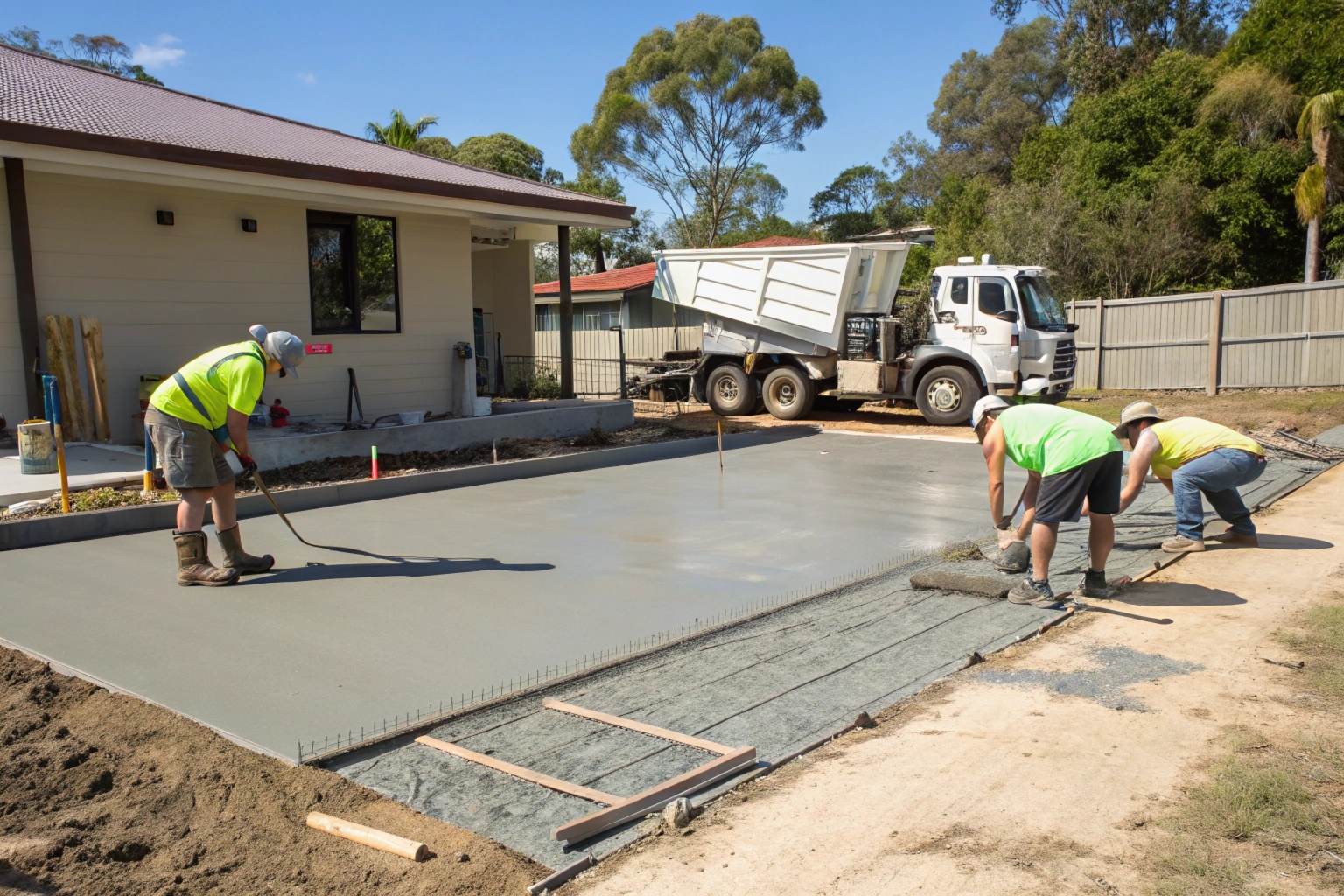
Concrete crew pouring and screeding a garage slab at a Gold Coast home

Not all slabs are created equal — and the right approach for your project depends entirely on what you’re building, where you’re building it, and what it needs to carry. Here’s a rundown of the slab types we cover:

House Slabs. A house slab is the single most important concrete pour on any residential build. It needs to be engineered to suit the site classification, reinforced correctly, and finished to tolerances that allow the rest of the build to go up true and level. We work from engineer’s drawings and coordinate with your builder to hit every benchmark from formwork through to final finish.

Garage Slabs. Garage slabs need to handle vehicle loads, resist oil and moisture penetration, and drain correctly — which means fall and surface finish matter just as much as strength. We get the details right so your garage floor stays functional and looking good long-term.

Shed Slabs. Whether it’s a small garden shed or a large steel-framed structure, the slab underneath sets the performance standard for everything above it. We size the slab and reinforcement to match the shed footprint and intended use.

Patio Slabs. Outdoor entertaining spaces on the Gold Coast take a hammering from UV, heat, and seasonal downpours. A well-poured patio slab with correct drainage fall and a quality surface finish gives you a base that performs year after year.

Commercial Floor Slabs & Suspended Slabs. For warehouse floors, factory slabs, mezzanine levels, and hardstand areas, load requirements and surface tolerances jump significantly. We cover commercial applications in a dedicated section below.

GET YOUR INSTANT FREE QUOTE NOW

    Newcastle Solar Power Google Reviews and Trust Badge

    What Goes Into a Quality Concrete Slab Installation

    A concrete slab might look straightforward from the outside — dig, pour, done. But the difference between a slab that performs for 30 years and one that starts cracking within 12 months comes down to what happens before the truck even pulls up.

    Here’s what a properly executed slab installation actually involves:
    Soil assessment and site preparation — stripping, compacting, and levelling the subgrade to create a stable base that won’t shift or settle unevenly under load
    Engineered design where required — for house slabs and any structural application, working from a geotechnical report and engineer’s specification rather than guessing
    Formwork — setting out the slab perimeter accurately so finished dimensions and levels are spot on from the start
    Steel reinforcement or mesh — correctly positioned and supported at the right cover depth, not just thrown on the ground and buried
    Concrete mix and compressive strength selection — matching the right mix design to the application, whether that’s 20MPa for a garden shed base or 32MPa for a structural house slab
    Pour sequencing — managing the pour so large slabs are placed and consolidated without cold joints or weak spots forming
    Surface finishing — achieving the right texture and flatness for the intended use, whether that’s a broom finish for a driveway apron or a power-trowelled finish for a commercial floor
    Saw cutting and joint placement — controlling where the slab cracks by placing control joints at the right spacing before shrinkage takes over
    Curing — keeping the slab hydrated in the critical early days so the concrete reaches its full design strength

    Every one of these steps matters. Skip or rush any of them, and the slab pays the price down the track.

    Gold Coast Soil Conditions and Why They Matter for Your Slab

    One of the things that separates a locally experienced concreter from someone just following a generic spec sheet is understanding what’s actually going on beneath your property — because on the Gold Coast, that varies enormously depending on where you’re building.

    In the beachside suburbs — Burleigh Heads, Palm Beach, Coolangatta — you’re generally dealing with sandy coastal soils. These drain freely but can be loose and poorly compacted, which means subgrade preparation and proper compaction testing are non-negotiable before a single metre of concrete goes down.

    Head inland and north into the newer growth corridors — Pimpama, Ormeau, Upper Coomera, Yarrabilba — and the picture changes completely. These areas are well known for reactive clay soils that expand when wet and shrink when dry. A slab poured without accounting for that movement is one that’s going to crack. It’s that simple.

    This is why residential slab design in Queensland operates under AS 2870 — the Australian Standard for residential slabs and footings. Every house slab needs a site classification that reflects the actual soil reactivity on that specific block, and the slab design needs to be engineered around that classification. We work directly with geotechnical reports and structural engineer specifications to make sure every house slab we pour is designed for the ground it’s sitting on — not a one-size-fits-all template that looks fine on paper but fails in the field.

    Whether you’re building in the sandy southern end or the reactive clay pockets up north, we know the Gold Coast’s ground conditions and we design and pour accordingly.

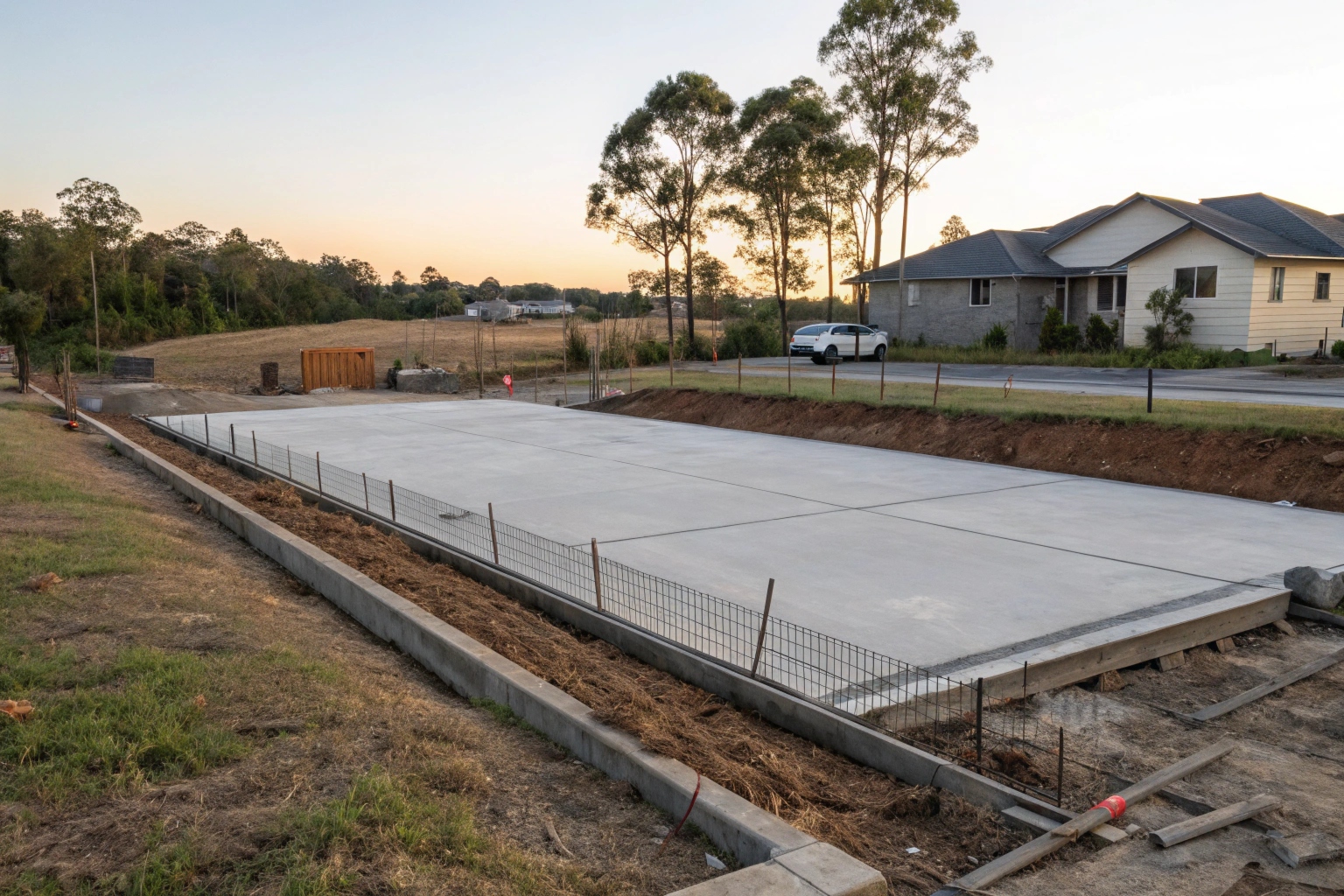
    Engineered concrete house slab with steel mesh reinforcement on a new Gold Coast residential lot
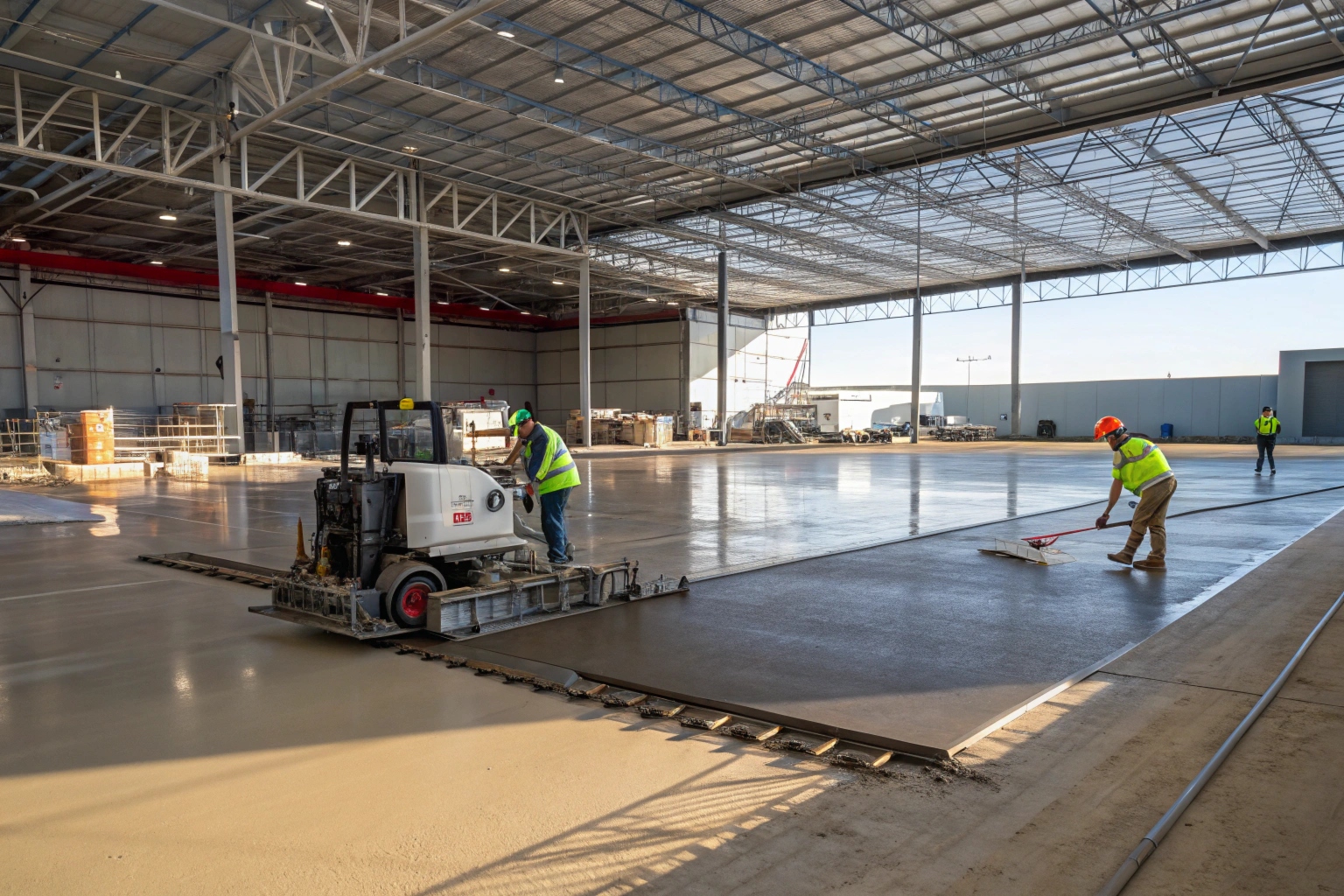
    Commercial warehouse concrete floor slab being poured with laser screed on the Gold Coast

    Slab Reinforcement — Choosing the Right Option for Your Project

    Reinforcement is what gives a concrete slab its structural backbone. Concrete is incredibly strong in compression — it handles weight well — but it’s relatively weak in tension, meaning it can crack under bending forces, ground movement, or point loads if there’s nothing inside holding it together. That’s where reinforcement comes in.

    We use three main reinforcement approaches depending on the application:

    Steel Mesh Reinforcement

    Mesh is the standard reinforcement for lighter residential applications — patio slabs, shed bases, garage floors, and pathway slabs where loads are relatively modest and ground conditions are stable. It’s cost-effective and, when installed correctly with proper cover and support, does exactly what it needs to do.

    Steel Bar (Reo) Reinforcement

    For house slabs, retaining structures, and any slab carrying significant point or distributed loads, steel bar reinforcement — laid out to an engineer’s specification — provides the strength and ductility that mesh alone can’t deliver. Reo slabs are also the standard response to reactive soil conditions, where the slab needs to act as a stiffened raft and resist differential ground movement beneath it.

    Fibre-Reinforced Concrete

    Polypropylene or steel fibre additives mixed directly into the concrete are increasingly used for industrial floors, hardstand areas, and applications where crack control across large pours is the primary concern. Fibres don’t replace structural reo in most cases, but they work alongside it to reduce plastic shrinkage cracking and improve impact resistance.

    The right reinforcement method isn’t a guess — it’s a decision based on your site, your slab’s intended purpose, and the engineering requirements that apply. We’ll always recommend the correct approach for your specific project, not just the cheapest one.

    Commercial and Industrial Slab Applications on the Gold Coast

    Residential slab work and commercial slab work share the same fundamentals — but the stakes, the specifications, and the execution requirements are in a different league when you’re talking about warehouse floors, factory slabs, hardstand areas, and suspended mezzanine levels.

    Higher Load Requirements

    A domestic garage slab designed for two family cars is a very different proposition to a warehouse floor carrying forklift traffic, pallet racking systems, and heavy machinery. Commercial and industrial slabs need to be engineered for the specific load cases they’ll see in service — both the static loads from racking and equipment, and the dynamic loads from vehicles moving across the surface. Getting that wrong isn’t just an expensive fix — it’s a safety issue.

    Surface Flatness and Finish Tolerances

    For commercial floors, surface flatness tolerances are tighter than most residential applications. A warehouse floor with high spots and dips causes problems with racking installation, forklift stability, and day-to-day operational efficiency. We use power trowel finishing on commercial pours to achieve the surface regularity that industrial and commercial clients need.

    Joint Design and Placement

    Large commercial floor slabs need a well-considered joint layout — control joints, construction joints, and isolation joints all placed with purpose. Poor joint design on a big pour is one of the most common causes of uncontrolled cracking in commercial floors, and it’s entirely avoidable with proper planning upfront.

    Suspended Slabs and Mezzanine Floors

    For mezzanine levels and elevated floor slabs, structural engineering input is non-negotiable. We work from structural drawings and coordinate with your engineer and building certifier throughout the process to make sure the finished slab meets every specification it needs to.

    Why Gold Coast Homeowners and Builders Choose Us for Concrete Slab Work

    When it comes to slab work, experience across every application type isn’t something you can fake. A team that’s only ever poured residential patio slabs isn’t the right choice for an engineer-specified house slab on reactive clay in Pimpama. And a crew that works exclusively on commercial floors might not appreciate the finish and detail expectations that come with a high-end outdoor entertaining area in Sanctuary Cove.

    We’ve built our business across the full spectrum of slab work on the Gold Coast — residential, commercial, and industrial — which means we bring genuine cross-application knowledge to every project we take on.

    Here’s what you can expect when you work with us:
    Licensed and insured — fully covered for every project type, residential or commercial
    Ability to work from engineer’s drawings — we read and execute to specification, and we communicate clearly with your engineer or building certifier throughout the process
    Experience across all slab types — house slabs, garage slabs, shed slabs, patio slabs, commercial floors, hardstand areas, and suspended slabs
    Local knowledge — we know Gold Coast soil conditions, local council requirements, and the climate factors that affect slab performance in this region
    Honest quoting — no hidden variations, no cutting corners on reinforcement or mix design to win the job cheapest

    Whether you’re a homeowner ready to start planning, or a builder looking for a reliable slab subcontractor who shows up, executes to spec, and gets out of the way so the rest of your build can move forward — we’d love to hear about your project.

    Get in touch today for a free quote on your Gold Coast concrete slab.

    Frequently Asked Questions About Concrete Slabs on the Gold Coast

    It depends on the application. A standard residential patio or shed slab is typically 100mm thick. Garage slabs are usually 100–125mm. House slabs are engineered to specification and vary based on site classification and soil conditions — they’re not something you guess at. Commercial and industrial floors often sit in the 150–200mm range depending on load requirements.

    For slabs associated with habitable structures — like a house, granny flat, or enclosed garage — a building approval is generally required. Smaller freestanding shed slabs and patio slabs may fall under exempt development depending on size and location. We’d always recommend checking with Gold Coast City Council or your building certifier before you start, and we can point you in the right direction if you’re unsure.

    Concrete reaches around 70% of its design strength within 7 days under normal curing conditions, and full design strength by 28 days. For most residential applications, formwork can typically come off after 24–48 hours, but loading the slab or starting framing work is something your builder and engineer will specify based on the design.

    Cracking in slabs usually comes down to one or more of these — poorly prepared subgrade, incorrect reinforcement placement, wrong concrete mix for the application, inadequate curing, or missing and poorly placed control joints. A lot of slab cracking is entirely preventable when the installation is done properly from the start.

    Yes — we can work to match existing levels, finishes, and slab depths for extension projects. Getting a perfect colour match on an existing concrete surface is harder to guarantee given weathering and age differences, but we’ll always discuss realistic expectations with you upfront.

    Absolutely. We work with owner-builders, licensed builders, and homeowners engaging us directly. Whoever is running the project, our approach is the same — clear communication, execution to specification, and a finished slab that does its job for the life of the structure.

    Get a Free Quote on Your Gold Coast Concrete Slab

    Whether you’re still in the planning stage or ready to get started, talking to the right team early makes a real difference. The decisions made before the first shovel goes in — soil assessment, slab design, reinforcement selection, concrete mix specification — are the decisions that determine how your slab performs for the next 30 years. Getting that advice from people who actually know what they’re doing on the Gold Coast is the smartest first step you can take.

    We work with homeowners, builders, and owner-builders across the full Gold Coast region — from the beachside suburbs in the south through to the fast-growing northern corridors of Pimpama, Ormeau, and Upper Coomera, and everywhere in between. No project is too straightforward, and no project is too complex — if it needs a concrete slab, we can help.

    Here’s what happens when you get in touch:
    We have a conversation about your project — what you’re building, where, and what you’re working with in terms of existing plans or engineering specs
    We visit the site to assess conditions and take measurements where needed
    We provide a detailed, itemised quote with no hidden costs or vague allowances
    We answer every question you have before you commit to anything

    There’s no pressure and no obligation — just honest advice from a team that does this work every day across the Gold Coast.

    Call us today or fill in the quote request form and we’ll get back to you within one business day.

    Because when it comes to concrete slabs, getting it right from the ground up isn’t just a good idea — it’s the only idea that makes sense.

    GET YOUR INSTANT FREE QUOTE NOW

      Newcastle Solar Power Google Reviews and Trust Badge

      Your Local Concrete Company in Gold Coast

      Back To Top CALL US NOW